
February’s Tip

Mulligan Mechanics Part XVIII Off – Center Bend – Root Control
By Dr. Kenneth Lau, IBO Diploamte, Master Senior Instructor, and North Central Section President
February 2026
201 North Main
Pendleton, IN 46064
United States
When selecting anterior orthodontic brackets, choose the bracket type according to the Mx incisor-to-SN angle measurement.
One of the goals of orthodontic treatment is to properly torque the Mx incisor angle to the normal Mx incisor to SN range of 103° +/- 4°.
The Edgewise Bracket has zero torque. All torque and tip adjustments will be made with the three orders of wire bending.
The Andrews Bracket torques the maxillary incisor by 7°, and the torque will bring the Mx incisor to SN angle of 97°.
The Roth bracket torques the maxillary incisor by 12°, and the torque will bring the Mx incisor to SN angle of 103°.
The MBT bracket torques the Mx incisor by 17°, and the torque will bring the Mx I to SN angle of 107°.
The Hilgers Bracket torques the Mx incisor by 22°, and the torque will bring the Mx I to SN angle of 112°. If the pretreatment Mx I to SN angle cephalometric measurement is 112°, the Hilgers Bracket should not be used. Roth will be a better choice.
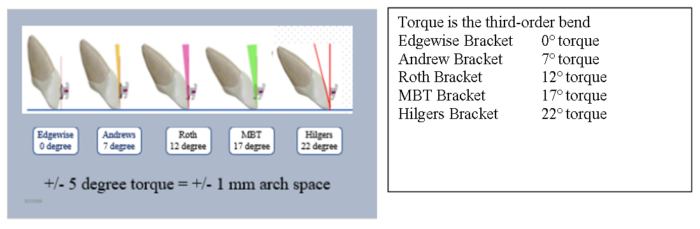
The image illustrates different orthodontic bracket torque values and their effect on a tooth’s labiolingual tilt. As torque changes, the crown tips forward or backward, while the root moves in the opposite direction. This concept is crucial for controlling tooth position and occlusion during orthodontic treatment. Remember that the built-in prescription does not guarantee a specific cephalometric final angle. Sometimes, a third-order bend is necessary to achieve the ideal Mx I-to-SN angle for a particular patient.